



PARK TSUETATE: Rent Your Own Ryokan in Tsuetate Onsen
public: 2025.12.10
writer:lily

I’m Rosy, a Canadian writer who has spent the last decade exploring Kumamoto and Kyushu’s onsen towns. Some are bustling and world-famous, others more reserved, content to let their long history speak for itself. Tsuetate Onsen (杖立温泉) falls into the latter category: a riverside town that still carries the quiet pride of its past.
Recently, a new kind of stay opened here: PARK TSUETATE, a self-check-in, full-building rental ryokan where you get the entire place to yourself. No staff, no dinner service, no one to fold your futon—just you, the creak of hardwood floorboards, and a lot of hot water.
It’s a bold experiment in how Japan’s most traditional form of accommodation might adapt to modern travel. So I went to see what it feels like when a ryokan decides to run itself.
Contents
PARK TSUETATE – The Ryokan Reimagined for the Future
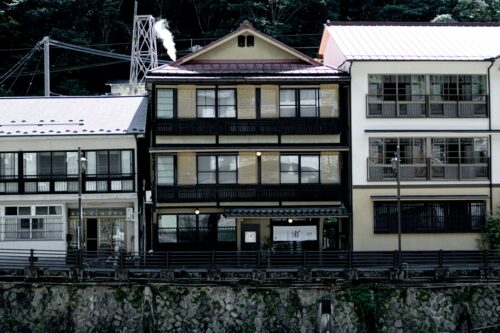
Opened in August 2025, PARK TSUETATE (Japanese: 泊° TSUETATE) is not a typical hotel—it’s a one-party-per-night, whole-building rental ryokan where guests have the entire three-storey inn to themselves. Designed for both small groups and stays of up to 20 people, it combines the nostalgia of a century-old hot spring inn with the freedom of a completely private stay.
The building itself has a long story: it was originally constructed in 1929, when Tsuetate Onsen thrived as one of Kyushu’s busiest hot spring resort towns. Over the decades, depopulation, floods, and the ageing of local proprietors took their toll. The previous owners—an elderly couple who had lovingly maintained the inn for decades—chose to close when they began to worry about how they could safely handle guests in the event of a natural disaster. With no heir to take over, they passed the property on to new caretakers who saw an opportunity to preserve its charm in a new form.
• Type: Self-check-in, full-building private ryokan (unstaffed)
• Location: Tsuetate Onsen (杖立温泉), Oguni, Kumamoto, Kyushu
• Capacity: Up to 20 guests (multiple tatami rooms)
• Baths: Two private onsen baths, open 24 hours
• Kitchen: IH stove, rice cooker, dishwasher
• Opened: August 2025
Staying Here
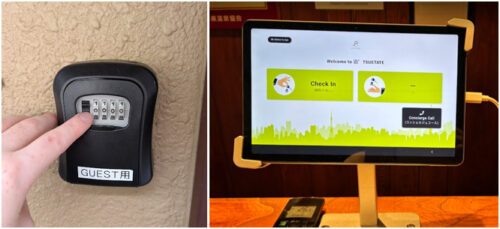
As this is an entirely unstaffed, self-check-in establishment, everything from check-in to check-out is contactless. After reserving online, guests receive a PIN code that unlocks the front door—no front desk, no staff. The system feels futuristic, but the building itself retains the warm, nostalgic atmosphere of a Showa-era ryokan.
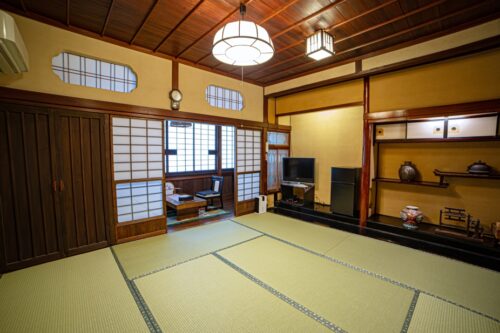
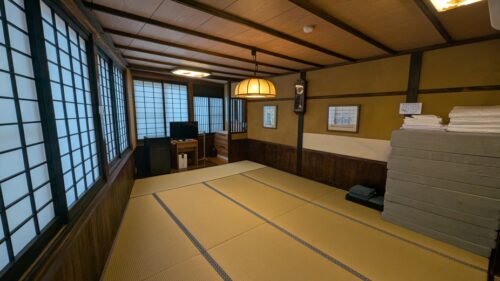
Guest rooms on the second and third floors are all traditional tatami-mat rooms of varying sizes. One of the playful charms of staying here is that, instead of being assigned a room, you can wander through the inn and choose your favourite. Lay out your own futon, slip between the soft sheets, and make yourself at home.
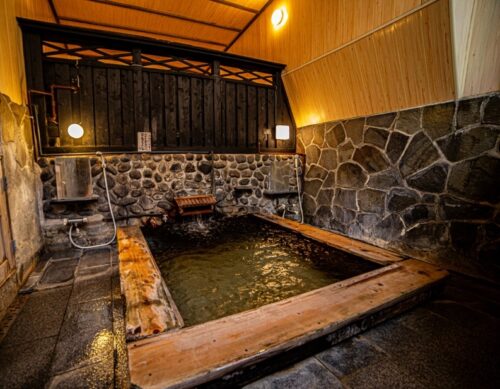
Inside, there are two private onsen baths, fed 24 hours a day by Tsuetate’s natural hot springs. There’s no need to wait for anyone to fill the tub, and no closing hours—you could soak at 3 a.m. if you wanted. Larger groups can divide bath time by family, by gender, or by couple—but how you use them is entirely up to you.
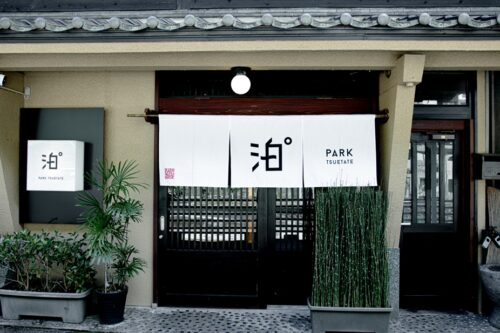
This sense of exploration inspired the property’s name. It’s a bit convoluted, but this is the idea: In Japanese, the name of the establishment is 泊° TSUETATE—the kanji character meaning “to stay overnight” (haku) combined with the stylistic addition of a degree sign (°) evoking “warmth”. A similar diacritic sign (゚) called a handakuten is also used in the kana syllabary to change ‘h’ sounds to ‘p’ sounds; hence PARK. And here is the connection—a park is a place of freedom where young children can roam and imagine their own world. The concept invites guests to “stay like you’re playing at a park,” to revisit those childhood instincts and move through the ryokan at your own pace.
The Kitchen and a Taste of Local Life
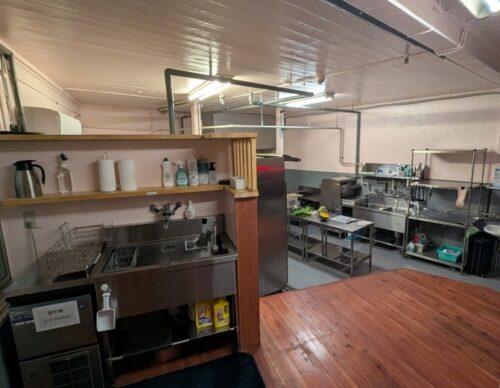
Being entirely unmanned, PARK TSUETATE does not provide breakfast or dinner, but it does give you access to their fully equipped kitchen—once used to prepare elaborate kaiseki meals. There’s a refrigerator, IH stove, rice cooker, and dishwasher, along with dishes, utensils, and basic cookware.
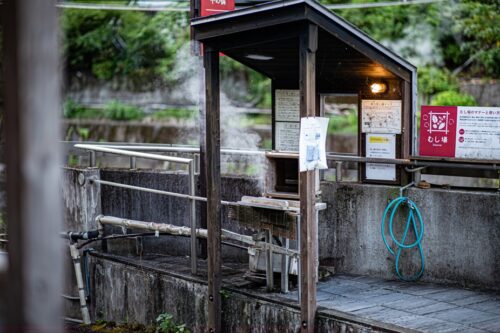
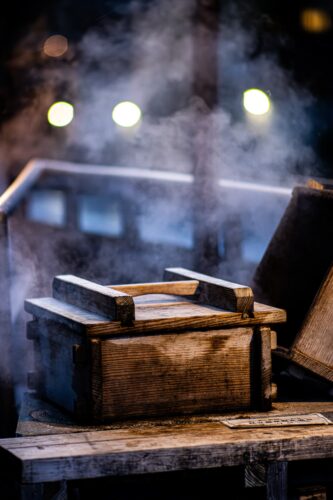
Along the river near the ryokan, you can find several mushiba (蒸し場), communal steam ovens powered by the natural heat of the springs. Locals use them to cook eggs, sweet potatoes, and seasonal vegetables—and visitors can try it too.
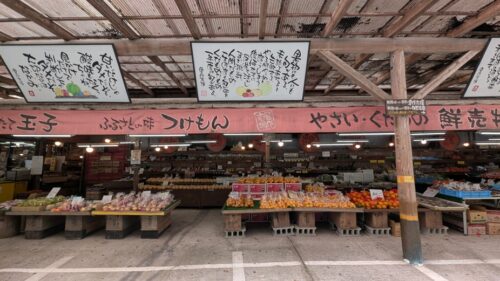
Before visiting, you can stop by Hōsaku Ichiba (豊作市場), a nearby farmers’ market overflowing with local produce—greens, sweet potatoes, shiitake mushrooms, tofu, and seasonal fruits. For meat products or other groceries you might want, the supermarkets in Oguni Town (or in Hita if you are coming from Oita) are an easy stop on the way.
Where is Tsuetate Onsen?
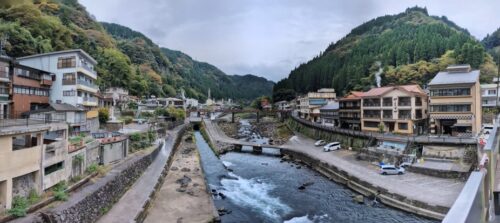
Tsuetate Onsen is a riverside hot spring town located in the northeastern corner of Kumamoto Prefecture, between the mountains of Aso and the border with Oita. Its inns cling to the slopes along the Tsuetate River, where ribbons of steam drift along the valley on Kyushu, Japan’s southernmost main island.
Though located in between popular destinations like Kumamoto’s famed Aso caldera, Kurokawa Onsen, and Oita’s hot spring havens of Yufuin and Beppu, Tsuetate remains remarkably tranquil.
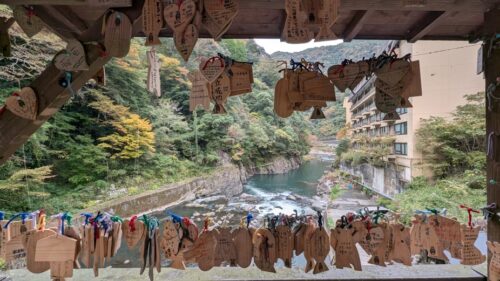
Local lore claims its springs were discovered over 1,800 years ago by a member of the imperial family, while another legend attributes the town’s name to the Buddhist monk Kūkai, who, after returning from Tang China, planted his staff (tsue) in the ground—where it miraculously sprouted leaves.
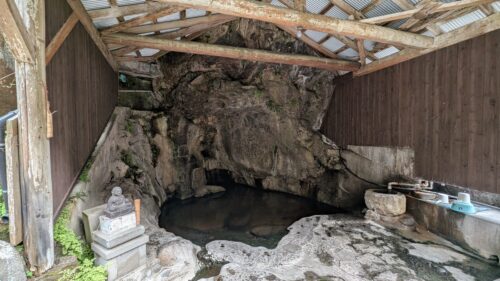
Whether or not these specific tales are literally true, Tsuetate has been known as a place of tōji (湯治)—extended stays for healing in mineral-rich waters. The town also flourished during Japan’s Showa era (1926–1989), a time of rapid growth and booming domestic travel, and families and company groups filled the town’s narrow streets. When travel shifted towards newer destinations, Tsuetate’s lively nights faded into memory. Yet the town’s cinematic calm—and its timeless steam—remain, quietly preserving the atmosphere of another Japan.
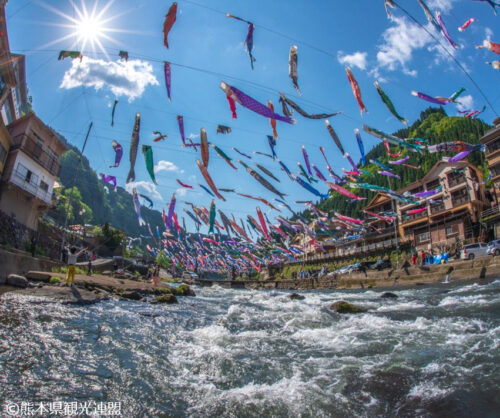
From April to early May, the valley brightens with colour during the Carp Streamer Festival, when hundreds of koinobori flutter above the river to celebrate Children’s Day. The sight of hundreds of cloth fish swimming through the sky has become one of the most recognisable images of Tsuetate.
The Owner’s Vision – Reviving Japan’s Small Towns
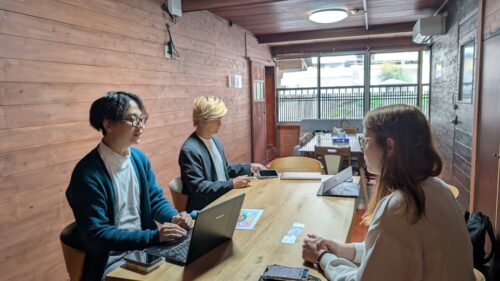
I sat down with the owner of PARK TSUETATE, Mr. Yamaura, to learn why he decided to open this ryokan and how he’s rethinking what hospitality can mean in rural Japan.
When asked why he chose the unusual model of a self-check-in, fully private ryokan, he was quick to answer:
“Unmanned operation is one way to tackle Japan’s growing labour shortage in the hospitality sector. If this approach succeeds, it could become a model for other small inns in the area that face the same challenge. Our goal is to prove that technology and tradition can coexist—and then return that success to the local community.”
The “one-group-per-stay” format also serves a dual purpose:
“It minimises the risk of conflicts between unrelated guests and, at the same time, lets families or groups enjoy the rare luxury of having an entire hot spring inn to themselves.”
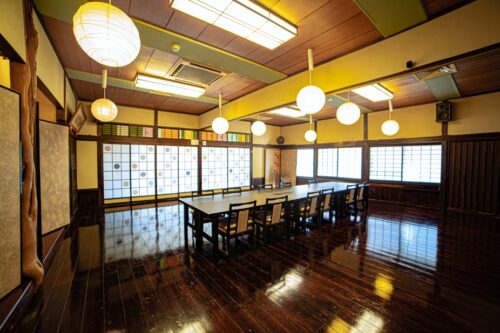
Inside, much of the original architecture has been carefully preserved. The inn, formerly known as Ryokan Wakanoya, is now more than a century old, yet its wooden beams and paper-screen doors remain in remarkable condition. The owner explained that this was no accident:
“The previous proprietors took such meticulous care of the building that we wanted to keep as much as possible intact. You can still feel their affection in every corner.”
In fact, the couple who once ran Wakanoya still live nearby—and remain part of its story. They’re now employed by the new management, helping with maintenance and upkeep, allowing them to stay connected to the ryokan they once considered their life’s work.
A New Model for Regional Renewal
The owner hopes PARK TSUETATE will do more than attract guests; he wants it to shine a light on what’s possible for ageing onsen towns across Japan.
“If a historic inn like this can be reborn through innovation, maybe others will find hope to continue as well.”
The renewed attention, he says, could help raise the profile of Tsuetate Onsen itself, which has struggled with depopulation and economic decline.
While large cities in Japan are grappling with overtourism, Tsuetate offers the opposite problem: relatively few visitors. Yet the owner believes responsible tourism (including visitors from overseas) can coexist with local life:
“Tourism only works when it grows together with the local culture. Tsuetate is a quiet, atmospheric town, so we ask guests to be mindful—keep noise low, dispose of waste properly, and treat the neighbourhood respectfully.”
A Stay That Encourages Reflection
Even though the ryokan operates without on-site staff, guests are never truly alone. A 24-hour phone line is available for assistance, and a security service can respond on site if needed. The baths run continuously, towels are provided, and the owner gently reminds visitors, for their own safety, not to bathe after drinking alcohol.
As our conversation drew to a close, he summed up his philosophy:
“Because there’s no staff, there’s also no barrier between you and the place itself. You can hear the river, feel the old wood, and notice the silence. I hope people experience that sense of calm—something that feels separate from the everyday world.”
Exploring Around PARK TSUETATE
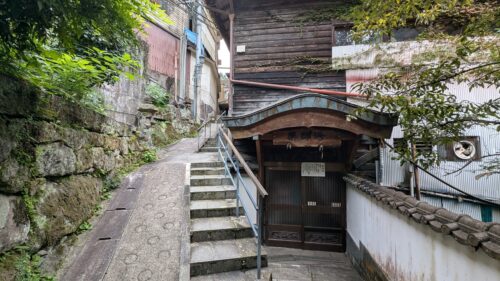
Stepping out from PARK TSUETATE, you find yourself in a town shaped by water and steam, centred on the river. A quiet stroll reveals some of the town’s most atmospheric corners. Behind the main street you’ll find the setoya, a warren of narrow back alleys where stairways twist between old ryokan.
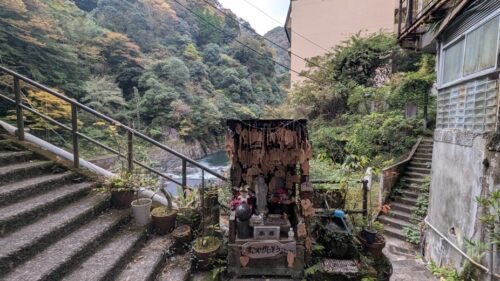
Scattered throughout the town are small Buddhist statues, including Jizō Bodhisattva, and the Yakushi Nyorai Hall dedicated to the medicine Buddha.
Nearby Spots
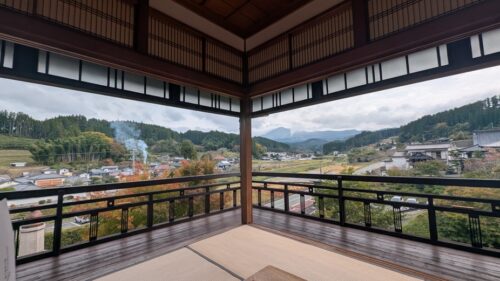
Leaving Tsuetate proper, there are several scenic sites that are within a short drive:
・Shimojō Giant Ginkgo Tree – A giant ginkgo more than 1,000 years old, designated a national natural monument. In autumn its golden leaves turn the hillside into a glowing canopy. It stands directly beside Shimojō Waterfall.
・Nabegataki Falls – A 9-metre-high waterfall known for the path that runs behind its curtain of water.
・Kitasato Shibasaburō Museum – Dedicated to the pioneering physician and bacteriologist born in Oguni, now featured on the new Japanese 1000 yen note, the museum presents his life and achievements in medicine, as well as his old family home, a library, and a guest house he built in his later years.
A Good Base for Kyushu Travel
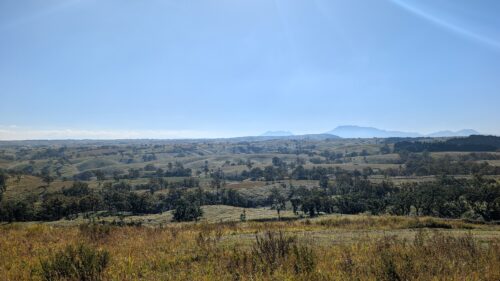
Travelling a little bit further by car, you can also reach Kurokawa Onsen, known for its open-air baths and quiet charm; both the Aso and Kuju Mountains, with hiking routes and broad views over Kyushu’s volcanic landscape; and Hita, a historic riverside town in neighbouring Oita Prefecture, home to the Attack on Titan Oyama Dam Statue.
For travellers—especially those who enjoy independent travel in Japan—planning to spend a few days deep in Kyushu’s mountains, PARK TSUETATE offers a practical and comfortable base—large enough for groups, peaceful enough for reflection, and close to some of the region’s most memorable landscapes.
Making a Reservation
Reservations for PARK Tsuetate can be made online through Booking.com and Airbnb. To check current rates, enter your travel dates on the booking site, but the more people in your party, the more affordable the cost per person becomes.
PARK TSUETATE Official Website: https://park-stay.com/
Booking.com Listing: https://www.booking.com/hotel/jp/bo-park-tsuetate.ja.html
Airbnb Listing: https://www.airbnb.jp/rooms/1478814905143310084
Getting to PARK TSUETATE
By Car
From Fukuoka City: Take the Kyushu Expressway → Tosu JCT → Oita Expressway → exit at Hita I.C., then follow National Route 212 south to Tsuetate Onsen. Approx. 1 h 30 min.
From Kumamoto City: Take National Route 57 east towards Aso, then follow Route 212 north through Oguni Town. Approx. 1 h 40 min.
From Beppu / Yufuin / Oita: Follow the Oita Expressway towards Hita, then continue on Route 212 south. Approx. 1 h 20 min.
Parking: on-site parking is available for guests arriving by car.
By Public Transport
From JR Hita Station (on the Kyūdai Line): Take a bus to Tsuetate Onsen. Approx. 40–50 min.
From Fukuoka (Hakata / Tenjin) / Fukuoka Airport: Highway bus towards Kurokawa Onsen (get off early at the Tsuetate stop). Approx. 2 h 30 min.
In Summary
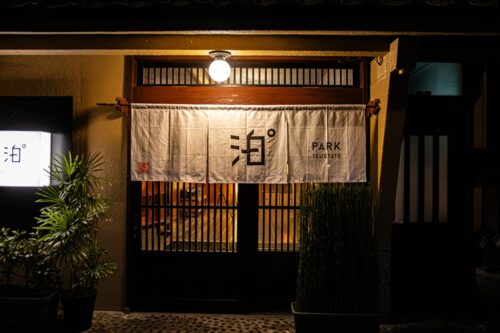
PARK TSUETATE embodies a quiet evolution in Japan’s ryokan culture—one that honours the past while gently redefining hospitality for the present day. The building itself is steeped in warmth and history, yet its self-check-in system and full-building rental format introduce a sense of independence that is unique in Japan’s hot spring towns.
In most ryokan, omotenashi—the tradition of anticipating every guest’s need—is expressed through carefully timed meals, futons laid out by staff, and the constant presence of attentive hosts. PARK TSUETATE, by contrast, entrusts these rituals to the guests themselves. You decide when to eat, when to bathe, which room to sleep in, and how to move through the space. In doing so, the experience becomes more personal—less a performance of hospitality and more an invitation to inhabit the inn as your own. For those seeking something authentic yet unpretentious, PARK TSUETATE offers a new way of finding peace in simply being left alone.
PARK TSUETATE
TRANSLATOR
lily
Born in Canada, adulting in Kumamoto. Kumamoto is a pretty amazing place, and I'm trying my best to do it justice ;)
Related Articles




 Editor's Recommended


PUBLIC RELATIONS PR記事


-
Official SNS
-





SHARE